The CTO’s Guide to the Hybrid ‘Build & Buy’ Architecture
In the traditional theater of enterprise IT, the decision to acquire new capabilities was a binary zero-sum game: you either bought a Commercial Off-The-Shelf (COTS) product and lived with its limitations, or you spent millions building a custom solution from scratch. Today, that binary choice is dead. In a landscape defined by rapid AI integration and shifting regulatory demands, the most successful technical leaders are moving toward a Hybrid Integration Layer.
This architecture allows organizations to leverage the stability of enterprise-grade SaaS for commoditized functions while focusing their engineering “innovation tokens” on the proprietary logic that actually drives market differentiation. The goal is no longer “Build vs. Buy,” but rather “Assemble and Extend.”
The Integration Layer Pattern: Architecting for Agility
The heart of a hybrid strategy is the Abstraction Layer. Without a secure, well-architected middleware layer, typically built in high-performance environments such as Node.js or Go, your custom code becomes tightly coupled to your vendor’s API. If that vendor changes their data model or deprecates an endpoint, your entire system risks a cascade failure.
By implementing an API-first integration layer, you create a “buffer zone.” This layer handles the heavy lifting of data transformation, authentication, and rate limiting. It protects your legacy core and COTS engines from the volatility of rapid front-end innovation. When you build this abstraction correctly, you can swap vendors or refactor backend logic without ever touching the user interface. This is the cornerstone of Composable Application Architecture, a standard that high-growth technical teams are adopting to avoid future technical debt.
Accelerating Integration Development with AI Assistance
Modern AI tools like Claude can significantly accelerate the development of these integration layers. When architecting API wrappers and data transformation pipelines, AI-assisted development helps engineering teams rapidly prototype integration patterns while maintaining code quality. However, the architectural decisions, what to abstract, how to structure your middleware, and which vendors to integrate, must remain firmly in human hands.
TCO vs. ROI Modeling: The Hidden Costs of the Binary Choice
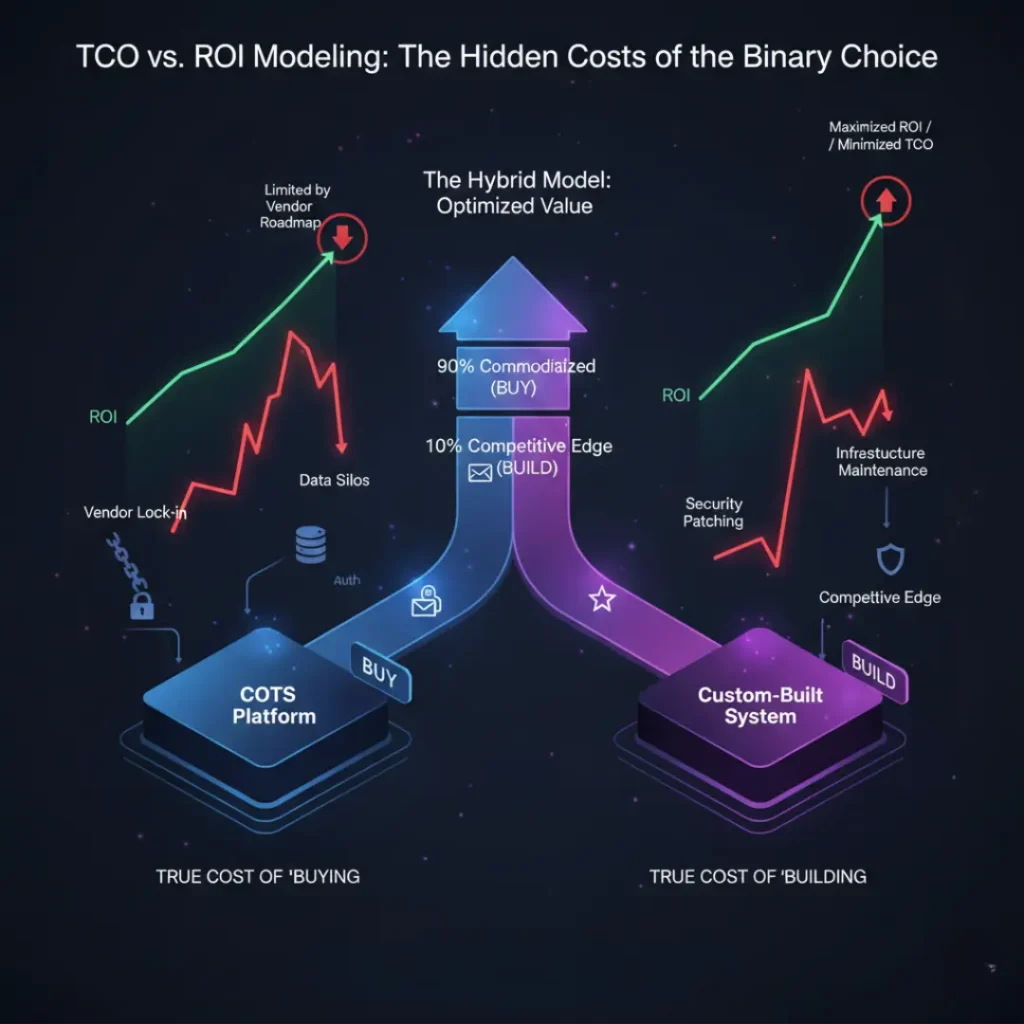
When evaluating a hybrid approach, a simple price-per-seat comparison is insufficient. CTOs must perform a deep dive into Total Cost of Ownership (TCO) versus the Return on Investment (ROI) of customization.
The True Cost of ‘Buying’
The “Buy” side often hides costs in Vendor Lock-in and Data Silos. When your data is trapped in a proprietary cloud, the cost of extracting it for AI training or cross-platform analytics can be astronomical. Furthermore, you are at the mercy of the vendor’s roadmap. If they don’t prioritize a feature your customers demand, your ROI plateaus while your subscription costs keep rising.
The True Cost of ‘Building’
Conversely, the “Build” side is often underestimated in terms of Infrastructure Maintenance and Security Patching. Building a custom wagering engine or a healthcare patient portal isn’t a one-time expense. You are committing to a lifetime of Software Configuration Management and constant updates to stay ahead of the NVD (National Vulnerability Database) listings.
The hybrid model optimizes this by “Buying” the 90% of the stack that is commoditized (e.g., auth, email, basic CRM) and “Building” only the 10% that provides the competitive edge.
Security Parity: Maintaining Standards Across the Hybrid Stack
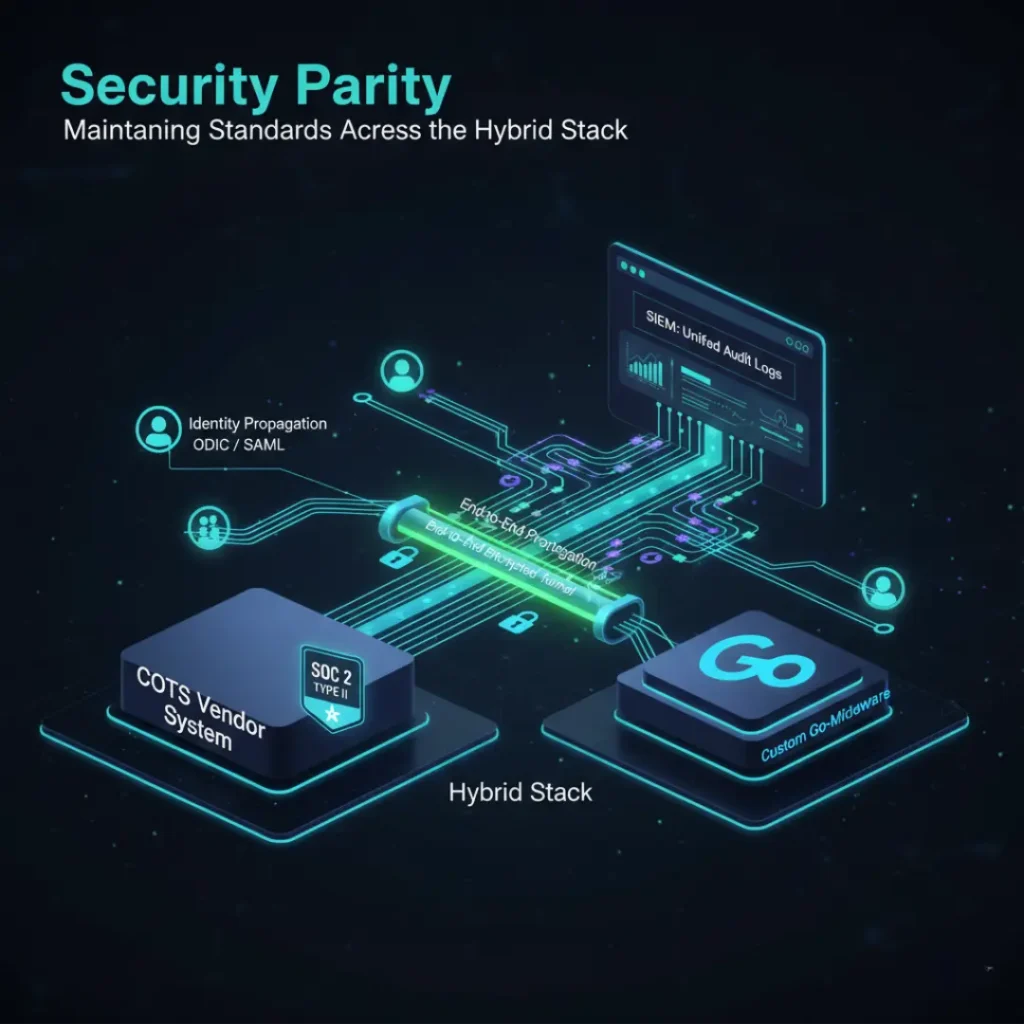
One of the greatest risks in a hybrid architecture is Compliance Fragmentation. Your COTS vendor likely boasts a SOC 2 Type II report, but as soon as you pipe their data through a custom Go-based middleware, the responsibility for security parity shifts to you.
To maintain SOC 2 Type II and PCI DSS standards, your custom-built modules must be architected with the same rigor as the enterprise engines they connect to. This means:
End-to-End Encryption: Ensuring data is encrypted not just at rest in the vendor’s database, but in transit through your integration layer.
Identity Propagation: Using standards like OIDC or SAML to ensure that a user’s identity and permissions are consistently enforced across both custom and purchased systems.
Audit Logging: Your integration layer must generate centralized logs that can be ingested by a SIEM, providing a unified view of security events across the entire hybrid environment.
Competitive Advantage Engineering: The 10% Rule
The most common trap for engineering teams is “over-building.” In a hybrid world, the most critical skill for a CTO is identifying the specific 10% of the stack that must be custom-built to maintain market differentiation.
Ask yourself: If my competitor buys the same SaaS tool tomorrow, what stops them from catching us?
If the answer is “nothing,” then you haven’t built your moat yet. Competitive advantage engineering focuses on:
- High-value logic
- Proprietary algorithms
- Unique data processing pipelines
- Specialized user workflows
These are elements that a generic COTS product simply cannot replicate. By utilizing NIST-recommended development life cycles, you ensure that this 10% is built to a standard that survives the test of scale, while the “bought” 90% handles the heavy lifting of standard operations.
The Path Forward: Scaling with Precision
Implementing a hybrid architecture is not just a technical shift; it’s a cultural one. It requires a team that understands how to dance with third-party APIs while maintaining the surgical precision of custom engineering.
At Hoyack, we specialize in this exact intersection. Our Enterprise Solutions are designed to help you modernize legacy platforms without the “rip and replace” risk. We provide Custom App Development that creates that vital 10% competitive moat, backed by AI-Powered Automation to keep your integrations efficient. If your internal team is stretched thin, our Instant Team Expansion service drops senior U.S. engineers directly into your workflow to execute this hybrid vision with SOC 2-compliant rigor.
Don’t let a binary “Build vs. Buy” decision stall your momentum or bury you in technical debt. Get our Buy vs. Build Blueprint today to access our full financial and technical modeling framework, and learn how to architect a system that leverages the best of both worlds for your next major project.