Chicago, Illinois
The World’s Derivatives Capital Runs
on Code Nobody’s Audited.
Chicago is home to CME Group, Cboe Global Markets, 30 Fortune 500 companies, and the densest concentration of proprietary trading firms on the planet. We’re the onshore engineering team that keeps the code behind it all documented and audit-ready.

Vibe Coding Just Shipped to a Trading System With No Audit Trail
AI-generated code ships fast and looks clean. Until your compliance officer finds the gap. When your code touches derivatives clearing, order routing, or risk models, “it passed review” isn’t a regulatory defense.
Your Offshore Dev Team Has Access to Trading Data
SEC, CFTC, and FINRA don’t care where your contractor is located. If they’re touching order flow, position data, or proprietary trading algorithms from overseas, you’re already exposed.
Your Risk System Was Built by a Contractor Who Left
One bad deployment, one missed dependency, one new engineer touching the wrong module, and your risk calculations, order routing, or clearing integrations go dark. In Chicago, downtime is measured in dollars per millisecond.
The Risks Nobody Talks About Until It’s Too Late
01
Vibe Coding Is a Regulatory Violation Waiting to Happen
Your dev team is using AI to ship faster. That’s fine. Until it isn’t. AI-generated code doesn’t get reviewed the way human-written code does. It introduces logic errors, insecure dependencies, and auth gaps that slip through code review because nobody fully understands what was generated. In a city where CME alone cleared 7.4 million contracts per day in 2025, one unchecked endpoint in a trading system isn’t just a bug. It’s a regulatory event with SEC, CFTC, and exchange consequences.
02
Offshore Isn’t Cheaper When Trading Data Leaves the Country
The hourly rate looks great. Then you add: timezone delays, miscommunication overhead, rework cycles, and the realization that order flow data, proprietary strategies, position records, and customer account information left the country. Chicago’s financial firms handle the most heavily regulated and performance-sensitive trading data in the world. One overseas exposure and your cost savings become a multi-agency enforcement problem.
03
Your Trading Infrastructure Is Held Together With Duct Tape
You’ve been adding to it, patching it, hiring contractors to “just keep it running.” But nobody really knows how all of it fits together anymore. The original dev left years ago. The documentation is a lie. One bad update, one deprecated library, one new exchange integration, and your order routing, risk management, or clearing systems go down. CME suffered a 10-hour outage from a single cooling issue in 2025. Your legacy system is no more resilient.
04
Compliance Gaps Don’t Wait for Your Renewal Date
SEC Rule 17a-4, CFTC regulations, PCI-DSS, GLBA. These aren’t annual checkboxes. They’re continuous requirements. Every new integration, every new team member, every infrastructure change is a potential gap. With 30 Fortune 500 companies and hundreds of trading firms in Chicago, regulators aren’t short on targets. The companies we talk to are almost always surprised to learn how many gaps they have.
05
Cyber Insurers Are Auditing Financial Services Code
The days of filling out a form and getting a policy are over. Underwriters are asking technical questions, especially in financial services and trading. Do you have MFA? How is your code reviewed? What’s your incident response plan? If vibe-coded features are processing trades, managing risk models, or handling customer accounts with no audit trail, your claim could be denied. Or your premium just tripled.
06
You’re Automating the Easy Parts, Not the Expensive Ones
Most teams automate the easy stuff. The hard stuff (legacy reconciliation workflows, manual compliance reporting, cross-system settlement integrations, regulatory filing pipelines) stays manual because nobody wants to touch it. That’s exactly where your operational costs are hiding. We’ve seen financial services firms cut 40+ hours of manual work per week by automating the workflows everyone assumed were too complicated.
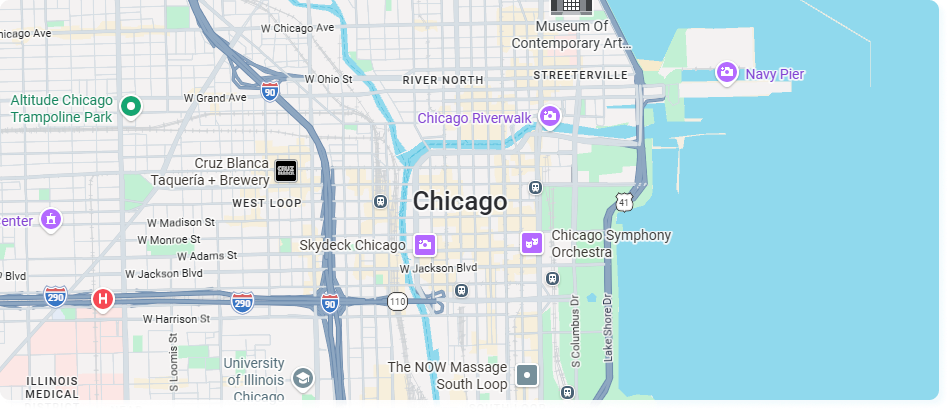
Built for the Companies That Keep This City Running
Chicago isn’t just another financial center. It’s the world’s derivatives capital, home to 30 Fortune 500 companies, the largest futures and options exchanges on the planet, and a proprietary trading ecosystem that moves billions daily. Named a top-five global fintech hub. That’s exactly where we operate best.
Exchanges & Market Infrastructure
The Code Behind the World’s Largest Derivatives Marketplace
CME Group is the world’s largest financial derivatives exchange, clearing 7.4 million contracts per day with record open interest of 9.8 million contracts in 2025. Cboe Global Markets operates markets across equities, options, futures, and digital assets, including the VIX volatility index. The Options Clearing Corporation (OCC) handles clearing for every listed options trade in the U.S. Every one of these systems runs on code that must meet exchange technology standards, SEC and CFTC regulations, and real-time performance requirements where latency is measured in microseconds.
Proprietary Trading & Quantitative Firms
Microsecond Markets Need Auditable Code
Chicago is the global epicenter of proprietary trading. Firms like Jump Trading, DRW, and Akuna Capital build algorithmic systems that execute millions of trades daily across futures, options, equities, and crypto markets. This code is the business: proprietary strategies, risk models, and execution algorithms represent billions in intellectual property. security attestation requirements, exchange connectivity standards, and the growing scrutiny from regulators and cyber insurers mean that vibe-coded systems and offshore access to trading infrastructure are liabilities that compound with every trade.
Insurance & Risk Management
Policyholder Data at Scale Demands Auditable Systems
Greater Chicago is a major insurance capital. Allstate manages over 208 million policies in force and generated $3.7 billion in net income in a single quarter. CNA Financial, Kemper, and a dense network of specialty insurers and reinsurers all operate from the region. These companies process massive volumes of policyholder PII, claims data, and actuarial models. State insurance regulations, security attestation requirements, and GLBA obligations create overlapping compliance surfaces. The offshore teams processing claims often have access that would concern your regulators and your policyholders alike.
Banking & Wealth Management
Institutional-Grade Assets Need Institutional-Grade Security
Northern Trust manages over $1 trillion in assets under management. BMO Financial Group runs one of North America’s largest banking operations from Chicago. Morningstar sets the standard for investment research and ratings. These firms handle institutional client data, fund accounting systems, and wealth management platforms that regulators, auditors, and clients examine under a microscope. Core banking integrations, digital platforms, and client portals all carry PCI-DSS, GLBA, and security attestation obligations that multiply with every new product and every new client onboarding.
Enterprise & Fortune 500 Operations
30 Fortune 500 Headquarters Need Enterprise-Grade Engineering
Chicago is the second-largest Fortune 500 city in America with 30 headquarters. These companies span aerospace, consumer goods, healthcare, retail, and food production, each carrying complex, multi-domain data obligations. Boeing’s defense contracts require CMMC compliance. Abbott handles FDA-regulated device data. Walgreens processes healthcare and retail data simultaneously. Cloud infrastructure, AI workloads, customer data, and supply chain systems all require compliance-first engineering that can’t be duct-taped on after launch.
Stop Duct-Taping. Start Automating.
Every patch you add to a 15-year-old system is borrowed time. You know the person who built it is gone. You know nobody fully understands what happens when X triggers Y. You know it’s going to break, you just don’t know when.
We go in, map the thing, document it properly, and build a modernization path that doesn’t take your operations offline. Then we find every manual process that should have been automated five years ago and we fix it.
40+
Hours/week recovered through automation
0
Offshore contractors touching
your data
100%
US-based
engineering team
1
Point of contact who actually
knows your stack

If You Handle Sensitive Data,
You Have Compliance Obligations. Full Stop.
We don’t just build software. We build software designed to hold up under an audit. Whether you’re preparing for security reviews, building to HIPAA requirements, or pursuing a DoD contract, we engineer with compliance in the architecture, not bolted on at the end.
SEC / CFTC
Securities and derivatives regulatory compliance, Rule 17a-4, trade reporting
PCI-DSS
Payment card security, transaction systems, banking and fintech infrastructure
GLBA
Financial data privacy, Safeguards Rule, consumer protection compliance
The Comparison Your CFO Needs To See
Offshore looks cheaper until you run the real numbers. Vibe coding looks faster until the auditor shows up.
Here’s what the comparison actually looks like.
Hoyack Core Service |
Hoyack (Onshore) |
Offshore/Vibe Coding |
|
HIPAA & compliance-safe code practices |
Built in from day one |
Assumed, rarely verified |
|
Data stays onshore (US soil) |
Guaranteed |
Often unclear or outright no |
|
Audit-ready code and logs |
Architected for it |
Retroactive fixes required |
|
Code review by human engineers |
Every commit |
AI-gen code often skipped |
|
Cyber insurance eligibility |
Documented & defensible |
Increasingly at risk |
|
Legacy system knowledge transfer |
Full documentation |
Knowledge walks when contract ends |
|
Real total cost (incl. rework, risk, delay) |
Predictable |
Unpredictable & compounding |
If You’re Not Sure Where Your Gaps Are, That’s the Problem.
We’ll do a no-pressure technical assessment of your current stack, compliance posture, and automation opportunities. You’ll walk away knowing exactly what’s at risk, and what it takes to fix it.