Dallas, Texas
Dallas Moves Fast. One Compliance Gap Moves Faster.
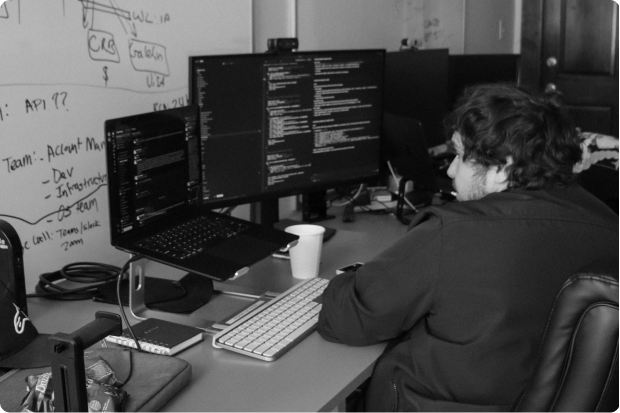
DFW is one of the most complex business environments in the country. Financial services, healthcare, defense, logistics, enterprise tech. Every one of those sectors runs on software that has to be secure, compliant, and reliable. We’re the onshore engineering team companies here trust when it matters.

AI-Generated Code Is Shipping Into Regulated Environments
Your team is moving fast. Nobody is stopping to ask whether the code that just passed review was actually reviewed. SOC 2 auditors and cyber insurers are starting to ask that question for you.
Offshore Developers Are Touching Data They Shouldn’t Be
HIPAA, PCI-DSS, and CMMC don’t have a carve-out for low hourly rates. If contractors outside the US are handling sensitive data, that exposure is already yours.
The System That Runs Your Operation Is One Update From Going Dark
Nobody fully documented it. The person who built it left. You’ve been patching it for years and hoping. That strategy has a deadline.
The Risks Nobody Talks About Until It’s Too Late
01
AI Code in Production Without Real Review
Speed is the sell. But AI-generated code introduces logic errors, insecure dependencies, and auth gaps that look fine on the surface. When a SOC 2 auditor or a cyber insurer digs into your codebase, they are not looking at intentions. They are looking at what shipped. Dallas companies in financial services and healthcare are already learning this the hard way.
02
The Real Cost of Offshore Development
The rate looks good until you add rework, timezone overhead, miscommunication cycles, and the compliance exposure that comes when data crosses a border. Under HIPAA, a 10,000-record breach starts at $1M in fines. That offshore team saved you $40 an hour. The math does not hold.
03
Legacy Systems Are a Quiet Operational Crisis
The original developer is long gone. The documentation doesn’t reflect reality. Every patch is borrowed time. DFW companies running logistics, healthcare, or financial operations on legacy infrastructure are one bad deployment away from explaining to clients why their data is unavailable. We’ve seen it. It’s always a surprise to the people it happens to.
04
Compliance Is Not a Once-a-Year Problem
HIPAA, SOC 2, CMMC, PCI-DSS. Every new team member, every new integration, every infrastructure change opens a potential gap. Most companies we talk to in Dallas are surprised by how many gaps they already have. Not because they were careless, but because nobody had eyes on it continuously.
05
Underwriters Are Reading Your Code Now
Cyber insurance got harder. Carriers are asking about code review practices, MFA, incident response plans, and production deployment processes. If you have AI-generated code in production with no audit trail, your next claim could be denied or your renewal premium could triple. Both happen.
06
The Manual Work You’ve Accepted as Normal Is Costing You
Teams automate what’s easy and leave the complicated stuff manual because touching it feels risky. That’s where the real cost hides. We find those workflows and fix them. Companies in DFW’s logistics and financial sectors have recovered 40 or more hours a week this way. That’s not a rounding error.

Built for the Companies That Keep This City Running
DFW is not a generic market. Each sector has specific compliance requirements, specific legacy
system problems, and specific risks that come with getting it wrong. We work inside all of them.
Financial Services & Fintech
From the Goldman Sachs Campus in Irving to DFW’s Growing Fintech Corridor
Dallas hosts one of the largest concentrations of financial services companies in the US. Regional banks, credit unions, insurance carriers, and fintech startups all handle data that regulators, auditors, and attackers watch closely. Payment flows, account systems, and customer APIs need to hold up under scrutiny, not just under normal load.
Healthcare & Health Systems
Baylor Scott and White, UT Southwestern, Children’s Health, Texas Health Resources
Dallas is home to one of the largest and most complex healthcare ecosystems in the country. The PHI exposure at that scale is significant. One misconfigured system, one unsecured API, one offshore contractor in the wrong place and you have a reportable breach. We build systems that are compliant before they go live, not patched into compliance after.
Defense & Government Contractors
NAS JRB Fort Worth and the Defense Contractor Corridor Across DFW
NAS JRB Fort Worth anchors a defense contracting ecosystem that runs across the metroplex. If your work touches the DoD or involves Controlled Unclassified Information, CMMC compliance is not optional. We build and maintain the systems that pass the audit and hold up through the ones after that.
Logistics, Supply Chain, & Distribution
DFW Airport, the Alliance Corridor, and the North Texas Inland Port
DFW is one of the busiest logistics hubs in North America. If your operation is still running on legacy TMS or WMS software, or relying on manual processes to move data between systems, the cost shows up every day in operational drag, errors, and visibility gaps. We fix the systems underneath so the operation runs the way it’s supposed to.
Enterprise Tech & SaaS
Las Colinas, Uptown, and the HQ Relocation Corridor
Dallas has become a serious enterprise tech market. HQ relocations, established ISVs, and a dense SaaS corridor from Las Colinas to Uptown means more companies carrying customer data at scale and the compliance requirements that come with it. We build software that holds up under due diligence, SOC 2 audits, and investor scrutiny.
Stop Duct-Taping. Start Automating.
Every patch you add to a 15-year-old system is borrowed time. You know the person who built it is gone. You know nobody fully understands what happens when X triggers Y. You know it’s going to break, you just don’t know when.
We go in, map the thing, document it properly, and build a modernization path that doesn’t take your operations offline. Then we find every manual process that should have been automated five years ago and we fix it.
40+
Hours/week recovered through automation
0
Offshore contractors touching
your data
100%
US-based
engineering team
1
Point of contact who actually
knows your stack

If You Handle Sensitive Data,
You Have Compliance Obligations. Full Stop.
We don’t just build software. We build software that can survive an audit. Whether you’re preparing for SOC 2, maintaining HIPAA posture, or pursuing a DoD contract, we engineer with compliance in the architecture, not bolted on at the end.
HIPAA
Healthcare data, PHI handling, covered entity and BA requirements
SOC 2
Type I & II readiness, security controls, audit trail architecture
CMMC
Defense contractor compliance, CUI handling, DoD supply chain requirements
PCI-DSS
Payment card security, transaction systems, fintech infrastructure
The Comparison Your CFO Needs To See
Offshore looks cheaper until you run the real numbers. Vibe coding looks faster until the auditor shows up.
Here’s what the comparison actually looks like.
Hoyack Core Service |
Hoyack (Onshore) |
Offshore/Vibe Coding |
|
Code practices built with HIPAA requirements in mind |
Built in from day one |
Assumed, rarely verified |
|
Data stays onshore (US soil) |
Guaranteed |
Often unclear or outright no |
|
SOC 2 audit-ready code & logs |
Architected for it |
Retroactive fixes required |
|
Code review by human engineers |
Every commit |
AI-gen code often skipped |
|
Cyber insurance eligibility |
Documented & defensible |
Increasingly at risk |
|
Legacy system knowledge transfer |
Full documentation |
Knowledge walks when contract ends |
|
Real total cost (incl. rework, risk, delay) |
Predictable |
Unpredictable & compounding |
If You’re Not Sure Where Your Gaps Are,
That’s the Problem.
We’ll do a no-pressure technical assessment of your current stack, compliance posture, and automation opportunities. You’ll walk away knowing exactly what’s at risk, and what it takes to fix it.