Colorado Springs, Colorado
NORAD. Space Command. Five Military Installations.
The Code Has to Be Mission-Ready.
Colorado Springs is home to NORAD, U.S. Space Command, five military installations, and 150+ defense contractors. Over 100,000 aerospace and defense workers. $3.3 billion in local economic impact. 400+ military separatees entering the civilian workforce every month. We’re the onshore engineering team that keeps mission-critical code documented and audit-ready.

Vibe Coding Just Shipped to a System That Touches CUI
AI-generated code ships fast and looks clean. Until your DCMA auditor or CMMC assessor finds the gap. When your code handles Controlled Unclassified Information for a DoD prime, “it passed review” isn’t a defense. It’s an incident.
Your Offshore Team Has Access to Defense Program Data
ITAR, CMMC, and DFARS don’t care where your contractor sits. If they’re touching export-controlled technology, CUI, or defense program data from overseas, you’re not just exposed. You’re potentially disqualified from the contract.
Your Mission Support System Was Built by Contractors Who Left
One bad deployment, one missed dependency, one new engineer touching the wrong module, and your satellite operations, missile defense support, or command control integration goes dark. In this city, downtime isn’t a business problem. It’s a national security event.
The Risks Nobody Talks About Until It’s Too Late
01
Vibe Coding Is a CMMC Violation Waiting to Happen
Your dev team is using AI to ship faster. That’s fine. Until it isn’t. AI-generated code doesn’t get reviewed the way human-written code does. It introduces logic errors, insecure dependencies, and auth gaps that slip through code review because nobody fully understands what was generated. In a city where defense contractors build mission-critical systems for NORAD, Space Command, and the Missile Defense Agency, one unchecked endpoint isn’t just a bug. It’s a CMMC assessment failure, a contract disqualification, and a potential compromise of national security data.
02
Offshore Isn’t an Option When CUI Is Involved
This isn’t about cost savings. It’s about eligibility. ITAR prohibits sharing defense-related technical data with foreign nationals without authorization. CMMC requires protecting CUI within U.S.-controlled environments. DFARS 252.204-7012 mandates specific cyber incident reporting. If your offshore team has access to export-controlled technology or defense program data, you’re not just exposed to penalties. You’re disqualified from competing for the contracts that sustain this city’s economy.
03
Your Mission Support System Is One Change Away From Failure
You’ve been adding to it, patching it, hiring contractors to “just keep it running.” But nobody really knows how all of it fits together anymore. The original dev left when the contract changed hands. The documentation was written for an audience that no longer exists. One bad update, one deprecated library, one new integration, and satellite operations, space domain awareness tools, or command control systems go dark.
04
CMMC 2.0 Is Here and Assessments Are Underway
CMMC is no longer theoretical. The DoD is requiring certified compliance as a condition of contract award. Level 2 requires third-party assessments against 110 NIST SP 800-171 controls. Every defense contractor in Colorado Springs that handles CUI needs to demonstrate compliance, and self-attestation is no longer sufficient for most contracts. The companies we talk to are almost always further behind than they think.
05
Cyber Insurers Are Asking Defense-Grade Questions
The days of filling out a form and getting a policy are over. Underwriters are asking technical questions that mirror CMMC controls. Do you have MFA everywhere? How is your code reviewed? What’s your incident response plan? Do you have a System Security Plan? If vibe-coded features are processing CUI or defense data with no audit trail, your claim could be denied. Or your premium just tripled.
06
You’re Automating the Easy Parts, Not the Expensive Ones
Most teams automate the easy stuff. The hard stuff (legacy mission support workflows, manual CMMC evidence collection, cross-system satellite data integrations, compliance documentation pipelines) stays manual because nobody wants to touch it. That’s exactly where your operational costs are hiding. We’ve seen defense contractors cut 40+ hours of manual work per week by automating the workflows everyone assumed were too complicated.
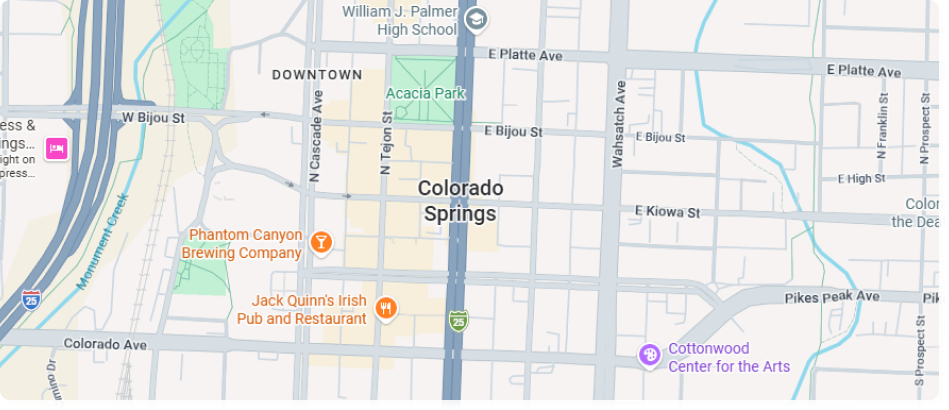
Built for the Companies That Keep This City Running
Colorado Springs isn’t just another defense town. It’s where NORAD monitors North American airspace, where Space Command conducts space operations, and where 150+ contractors provide the technology, intelligence, and engineering that make all of it possible. The aerospace and defense sector contributes $3.3 billion to the local economy and holds a 3.6% share of the national GDP. That’s exactly where we operate best.
Space & Missile Defense
The Code That Protects the Homeland Runs From Here
Colorado Springs is the operational center of America’s space and missile defense infrastructure. NORAD and U.S. Northern Command protect North American airspace from Cheyenne Mountain and Peterson Space Force Base. Schriever Space Force Base operates and supports DoD satellite constellations through the 50th Space Wing. The Missile Defense Agency maintains critical operations here. The Space Domain Awareness Lab brings together 40+ companies to solve space tracking challenges. Every system touching these missions handles classified or CUI data under the most stringent compliance requirements in any industry. CMMC Level 2, NIST SP 800-171, and ITAR create overlapping obligations where failure isn’t a business setback. It’s a threat to national security.
Defense Contractors & Systems Integrators
150+ Contractors. Billions in Contracts. Zero Tolerance for Gaps.
Colorado Springs hosts operations for nearly every major defense prime. Lockheed Martin builds space and defense systems. Northrop Grumman employs 3,500+ across Colorado with major Colorado Springs operations. L3Harris, Raytheon (RTX), Booz Allen Hamilton, Parsons, and KBR all operate from the region. Smaller defense-focused companies like Delta Solutions & Strategies (recently won a $187 million Space Command contract), Mobius (75 new jobs at $137,000 average salary), Infinity Technology Services, and Nooks (classified spaces as a service) are growing fast. Every one of these companies must demonstrate CMMC compliance as a condition of contract award. The prime flows CMMC requirements down to subcontractors, meaning every tier of the supply chain carries the same obligations.
Cybersecurity
Five NSA-Certified Colleges and a 50,000-Veteran Workforce
Colorado Springs has one of the most concentrated cybersecurity workforces in the country. Five National Security Agency-certified colleges produce cleared talent. Over 50,000 veterans and 70,000+ active military personnel create a workforce pipeline that understands security at an institutional level. 400+ military separatees enter the civilian workforce every month. The annual Peak Cyber Summit brings together DoD, government, and industry cybersecurity leaders. Companies building security tools, managed detection and response services, and compliance platforms for defense clients carry CMMC, and FedRAMP obligations simultaneously.
Satellite & Space Technology
The Commercial Space Industry Is Growing Alongside the Military One
Beyond the military missions, Colorado Springs is home to a growing commercial space technology cluster. Parsons is developing the Traffic Coordination System for Space (TraCSS) for NOAA’s Office of Space Commerce, building software to track and manage 30,000+ objects in orbit. Odyssey Systems supports acquisitions reform. York Space Systems is expanding its satellite manufacturing operations. These companies straddle commercial and government markets, often serving both simultaneously. That means their code must meet both commercial security attestation standards and government CMMC/ITAR requirements without compromising either. Dual-compliance architecture is not optional here.
Military Training & Simulation
Warfighter Readiness Starts With Code That Works
Fort Carson is the second-largest employer in Colorado, home to the 4th Infantry Division and the 10th Special Forces Group. The U.S. Air Force Academy produces the next generation of military leaders. Delta Solutions & Strategies creates military training products and modeling simulations, recently winning a $187 million contract as the primary contractor on U.S. Space Command. These organizations and their technology partners build virtual training environments, combat simulations, and readiness assessment tools that handle classified and CUI data. The code powering these systems must be resilient, documented, and compliant. When a training simulation fails, readiness gaps cascade into real-world operational risk.
Stop Duct-Taping. Start Automating.
Every patch you add to a 15-year-old system is borrowed time. You know the person who built it is gone. You know nobody fully understands what happens when X triggers Y. You know it’s going to break, you just don’t know when.
We go in, map the thing, document it properly, and build a modernization path that doesn’t take your operations offline. Then we find every manual process that should have been automated five years ago and we fix it.
40+
Hours/week recovered through automation
0
Offshore contractors touching
your data
100%
US-based
engineering team
1
Point of contact who actually
knows your stack

If You Handle Sensitive Data,
You Have Compliance Obligations. Full Stop.
We don’t just build software. We build software designed to hold up under an assessment. Whether you’re preparing for CMMC Level 2, implementing NIST SP 800-171 controls, maintaining ITAR compliance, or pursuing FedRAMP authorization, we engineer with compliance in the architecture, not bolted on at the end.
CMMC
Level 2 assessment readiness, CUI protection, NIST 800-171 control implementation
ITAR
Export control compliance, defense article restrictions, U.S. person requirements
FedRAMP
Cloud service authorization for government systems and DoD workloads
The Comparison Your CFO Needs To See
Offshore looks cheaper until you run the real numbers. Vibe coding looks faster until the auditor shows up.
Here’s what the comparison actually looks like.
Hoyack Core Service |
Hoyack (Onshore) |
Offshore/Vibe Coding |
|
HIPAA & compliance-safe code practices |
Built in from day one |
Assumed, rarely verified |
|
Data stays onshore (US soil) |
Guaranteed |
Often unclear or outright no |
|
Audit-ready code and logs |
Architected for it |
Retroactive fixes required |
|
Code review by human engineers |
Every commit |
AI-gen code often skipped |
|
Cyber insurance eligibility |
Documented & defensible |
Increasingly at risk |
|
Legacy system knowledge transfer |
Full documentation |
Knowledge walks when contract ends |
|
Real total cost (incl. rework, risk, delay) |
Predictable |
Unpredictable & compounding |
If You’re Not Sure Where Your Gaps Are, That’s the Problem.
We’ll do a no-pressure technical assessment of your current stack, compliance posture, and automation opportunities. You’ll walk away knowing exactly what’s at risk, and what it takes to fix it.