Tucson, Arizona
This Is Where America’s Missiles Are Built.
The Code Behind the Factory Floor Has to Be Airtight.
Raytheon headquarters for missiles and defense. 13,000 local employees. $55 billion in annual contract value. Five landmark framework agreements to supercharge Tomahawk, AMRAAM, SM-3, and SM-6 production. Optics Valley: $4 billion economic impact. Davis-Monthan Air Force Base. We’re the onshore engineering team that keeps the code behind it all documented and audit-ready.

Vibe Coding Just Shipped to a Missile Guidance Software System
AI-generated code ships fast and looks clean. Until the DCMA auditor or CMMC assessor finds the gap. When your code touches missile guidance algorithms, production line controls, or weapons system testing, “it passed review” isn’t a defense. It’s a manufacturing stop and a national security incident.
Your Offshore Team Has Access to Munitions Program Data
ITAR, CMMC, and DFARS don’t care where your contractor sits. If they’re touching missile specifications, weapons system schematics, or foreign military sales data from overseas, you’re disqualified from the contract and potentially facing criminal referral under ITAR.
Your Production Support System Was Built for a Slower Cadence
Raytheon is ramping Tomahawk production to 1,000+ per year and AMRAAM to 1,900+. Systems built to support lower production rates are being pushed to their limits. When production line software fails, missile deliveries to the warfighter and allied nations stop.
The Risks Nobody Talks About Until It’s Too Late
01
Vibe Coding Is a CMMC Violation Waiting to Happen
Your dev team is using AI to ship faster. That’s fine. Until it isn’t. AI-generated code doesn’t get reviewed the way human-written code does. It introduces logic errors, insecure dependencies, and auth gaps that slip through because nobody fully understands what was generated. In a city where the factory floor produces Tomahawk cruise missiles, AMRAAM air-to-air missiles, and SM-6 interceptors, one unchecked endpoint in a production support system isn’t just a bug. It’s a CMMC assessment failure, a manufacturing disruption, and a delay in deliveries that allied nations are counting on.
02
Offshore Isn’t an Option When Missile Data Is Involved
This isn’t about cost savings. It’s about eligibility and criminal liability. ITAR prohibits sharing defense articles and technical data with foreign nationals. Missile technology is among the most tightly controlled categories under ITAR and the Missile Technology Control Regime. Tomahawk has been used operationally over 2,300 times. AMRAAM serves the U.S. and 19+ allied nations. If your offshore team has access to any of this data, you’re not just exposed. You’re facing potential criminal prosecution.
03
Production Is Ramping Faster Than Your Systems Were Designed For
The five landmark framework agreements signed in February 2026 commit Raytheon to dramatically increasing annual production: Tomahawk to 1,000+, AMRAAM to 1,900+, SM-6 to 500+. These are up-to-seven-year agreements. Every system supporting this production ramp, from manufacturing execution to supply chain management to quality assurance, must scale accordingly. Systems built for a lower cadence will break under the new volume.
04
CMMC 2.0 Is Here and Tucson’s Supply Chain Is in the Crosshairs
CMMC is no longer theoretical. The DoD is requiring certified compliance as a condition of contract award. Level 2 requires third-party assessments against 110 NIST SP 800-171 controls. Raytheon flows CMMC requirements down to every tier of its supply chain. In a city where the defense ecosystem orbits a single dominant prime contractor, compliance failure doesn’t just cost you one contract. It costs you access to the entire Tucson defense economy.
05
Cyber Insurers Are Asking Weapons-Manufacturing-Grade Questions
The days of filling out a form and getting a policy are over. Underwriters are asking technical questions that mirror CMMC controls. Do you have MFA everywhere? How is your code reviewed? What’s your incident response plan? Do you have a System Security Plan? If vibe-coded features are processing missile production data, quality records, or supply chain information with no audit trail, your claim could be denied.
06
You’re Automating the Easy Parts, Not the Expensive Ones
Most teams automate the easy stuff. The hard stuff (legacy production tracking workflows, manual CMMC evidence collection, cross-system quality assurance pipelines, compliance documentation for subcontractor certifications) stays manual because nobody wants to touch it. That’s exactly where your operational costs are hiding. We’ve seen defense manufacturers cut 40+ hours of manual work per week by automating the workflows everyone assumed were too complicated.
Built for the Companies That Keep This City Running
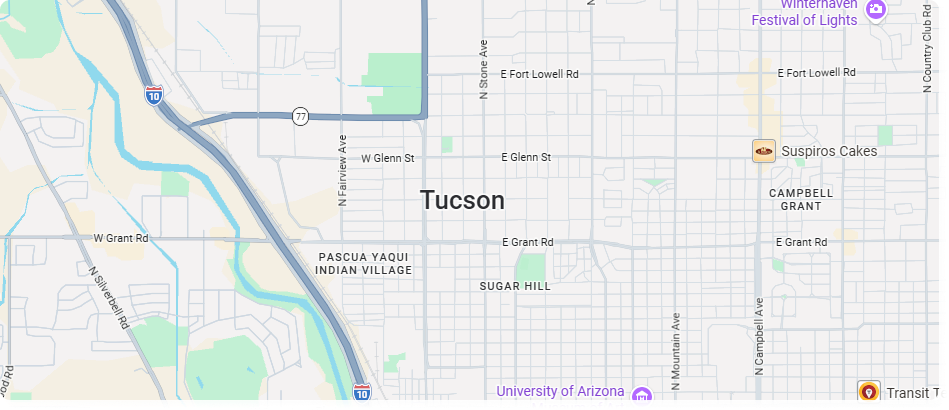
Tucson isn’t just another defense town. It’s where the Raytheon business segment of RTX is headquartered, where Tomahawk, AMRAAM, SM-2, SM-3, SM-6, and Stinger missiles are manufactured, and where the entire supply chain orbits a single dominant prime contractor whose production is ramping to meet global demand. That’s exactly where we operate best.
Missile Manufacturing & Weapons Systems
Tomahawk. AMRAAM. SM-6. Stinger. They’re All Made Here.
Raytheon is headquartered in Tucson for its entire missiles and defense business segment, the result of merging Raytheon Missile Systems and Raytheon Intelligence and Space. The company notched more than $55 billion in contract value during the last fiscal year. In February 2026, Raytheon signed five landmark framework agreements with the Department of War to supercharge production of Tomahawk (to 1,000+ annually), AMRAAM (to 1,900+), SM-3 Block IB, SM-3 Block IIA, and SM-6 (to 500+). A $3.5 billion AMRAAM contract was awarded in August 2025, the largest in the program’s history. These are up-to-seven-year agreements. Every system supporting this production ramp handles the most tightly controlled technical data in the defense industrial base. CMMC Level 2, NIST SP 800-171, ITAR, and the Missile Technology Control Regime create overlapping obligations where failure isn’t a business setback. It’s a national security event.
Defense Supply Chain & Subcontractors
When the Prime Flows Down CMMC, Every Tier Must Comply
Tucson’s defense economy is unusually concentrated around a single prime contractor. Northrop Grumman and Honeywell Aerospace maintain Southern Arizona operations. But the defining feature of this market is the Raytheon supply chain: hundreds of small and mid-size manufacturers, component suppliers, and engineering services firms whose revenue depends almost entirely on Raytheon subcontracts. When Raytheon flows down CMMC requirements, compliance isn’t optional for the supply chain. It’s a condition of continued business. And in a city where losing access to the Raytheon ecosystem means losing access to the entire defense economy, the stakes of a failed assessment are existential for small businesses.
Optics, Photonics & Sensor Technology
Optics Valley: $4 Billion Economic Impact and the World’s Largest Optics Program
Tucson is Optics Valley. The University of Arizona’s College of Optical Sciences is the world’s largest and most comprehensive optics program, with 150+ undergraduate and 350+ graduate students and 40+ faculty members. The Steward Observatory Mirror Lab, housed under the football stadium, fabricated the primary mirrors for the James Webb Space Telescope. Between 100 and 300 optics and photonics companies operate in Arizona, generating $4 billion in economic impact. Arizona ranks #1 nationally for job growth in optics and photonics. Southern Arizona and Southern Taiwan recently signed a six-party MOU to deepen semiconductor, optics, and photonics collaboration. These companies process proprietary optical designs, defense-related sensor specifications, and research data under overlapping ITAR, and IP protection requirements.
Davis-Monthan Air Force Base
The Base Is Evolving. The Contractor Ecosystem Must Keep Up.
Davis-Monthan Air Force Base is home to the 309th Aerospace Maintenance and Regeneration Group, which manages the world’s largest aircraft storage and regeneration facility. The base’s mission is expanding to include new operational capabilities, advanced technologies, and pilot training. The contractors supporting these missions build maintenance management systems, aircraft tracking platforms, logistics tools, and training environments. Every system handling military aircraft data, maintenance records, and operational readiness information carries CMMC and security attestation obligations. The base’s mission evolution creates new compliance surfaces for contractors who have been supporting legacy programs for years.
University Research & Defense Innovation
The University of Arizona Is Training the Next Generation and Building the Next Weapon
The University of Arizona is one of Tucson’s largest employers and a powerhouse in defense-relevant research. The Steward Observatory Mirror Lab builds some of the world’s largest telescope mirrors. UA researchers are developing a hypersonic database to speed Pentagon testing under a DoD-backed program. The university hosts a new DoD program to train students in military acquisition practices. Tech Parks Arizona operates the UA Science and Technology Park, home to defense, biotech, and optics startups alongside established firms like IBM and Raytheon. These research programs handle classified and CUI data, proprietary designs, and DoD-funded intellectual property under compliance frameworks that span CMMC, ITAR, and institutional data governance simultaneously.
Stop Duct-Taping. Start Automating.
Every patch you add to a 15-year-old system is borrowed time. You know the person who built it is gone. You know nobody fully understands what happens when X triggers Y. You know it’s going to break, you just don’t know when.
We go in, map the thing, document it properly, and build a modernization path that doesn’t take your operations offline. Then we find every manual process that should have been automated five years ago and we fix it.
40+
Hours/week recovered through automation
0
Offshore contractors touching
your data
100%
US-based
engineering team
1
Point of contact who actually
knows your stack

If You Handle Sensitive Data,
You Have Compliance Obligations. Full Stop.
We don’t just build software. We build software designed to hold up under an assessment, a DCMA audit, and an ITAR review. We engineer with compliance in the architecture, not bolted on at the end.
CMMC
Level 2 assessment readiness, CUI protection, NIST 800-171 control implementation
ITAR
Missile technology export controls, defense article restrictions, U.S. person requirements
DFARS
Defense procurement compliance, 252.204-7012 cyber incident reporting, CUI safeguards
The Comparison Your CFO Needs To See
Offshore looks cheaper until you run the real numbers. Vibe coding looks faster until the auditor shows up.
Here’s what the comparison actually looks like.
Hoyack Core Service |
Hoyack (Onshore) |
Offshore/Vibe Coding |
|
HIPAA & compliance-safe code practices |
Built in from day one |
Assumed, rarely verified |
|
Data stays onshore (US soil) |
Guaranteed |
Often unclear or outright no |
|
Audit-ready code and logs |
Architected for it |
Retroactive fixes required |
|
Code review by human engineers |
Every commit |
AI-gen code often skipped |
|
Cyber insurance eligibility |
Documented & defensible |
Increasingly at risk |
|
Legacy system knowledge transfer |
Full documentation |
Knowledge walks when contract ends |
|
Real total cost (incl. rework, risk, delay) |
Predictable |
Unpredictable & compounding |
If You’re Not Sure Where Your Gaps Are, That’s the Problem.
We’ll do a no-pressure technical assessment of your current stack, compliance posture, and automation opportunities. You’ll walk away knowing exactly what’s at risk, and what it takes to fix it.