San Marcos & Kyle, Texas
The Fastest-Growing Corridor in America.
The Code Has to Keep Up.
Hays County: fastest-growing county in the nation. Kyle: 1,000% population growth since 2000. San Marcos: fastest-growing U.S. city three years running. Amazon, CFAN, 240+ supply chain companies, and 12,000+ logistics employees. Texas State University with 39,000 students. Data centers, advanced manufacturing, and a megaregion heading toward 7 million people by 2030. We’re the onshore engineering team based right here in San Antonio that keeps the code behind it documented and audit-ready.

Vibe Coding Just Shipped to a System Built for 5,000 People
AI-generated code ships fast and looks clean. Until your platform serves a population that tripled while nobody was watching. When growth is this fast, systems that were prototypes become production overnight. The shortcuts that worked at startup scale become compliance gaps at the scale you’re operating now.
Your Offshore Team Is Building for a Megaregion From Overseas
PCI-DSS, and HIPAA don’t care where your contractor sits. The corridor between Austin and San Antonio is becoming a single economic megaregion. The companies serving 5 million people (soon to be 7 million) handle consumer data, payment records, and healthcare information. Offshore exposure multiplies per jurisdiction.
Your Infrastructure Was Built for a Bedroom Community
Kyle went from 5,000 residents to 66,000. San Marcos is approaching 91,000. 73% of Kyle’s workforce still commutes out. The systems supporting this growth were never designed for a corridor that Forbes called “America’s Next Great Metropolis.” The tech infrastructure is being built in real time, and compliance is an afterthought.
The Risks Nobody Talks About Until It’s Too Late
01
Vibe Coding Is a Scaling Disaster Waiting to Happen
Your dev team is using AI to ship faster. That’s fine. Until it isn’t. AI-generated code doesn’t get reviewed the way human-written code does. It introduces logic errors, insecure dependencies, and auth gaps that slip through because nobody fully understands what was generated. In the fastest-growing corridor in America, companies are scaling from startup to enterprise in compressed timeframes. The code that was “good enough” at 500 users becomes a liability at 50,000. The platform that handled one city now serves a megaregion. One unchecked endpoint isn’t just a bug. It’s a breach affecting the customers and residents of the fastest-growing communities in the country.
02
Offshore Isn’t Cheaper When You’re Scaling This Fast
The hourly rate looks great. Then you add: timezone delays that cost you a week when you need to ship in a day, miscommunication overhead that multiplies with every sprint, rework cycles that compound as the user base doubles, and the realization that consumer data, payment records, and logistics information for millions of people left the country. When your growth rate is measured in hundreds of percent per decade, offshore rework cycles aren’t just expensive. They’re existentially slow.
03
Growth Is Outpacing Compliance Everywhere
Kyle grew 1,000% since 2000. San Marcos doubled in population. 2 million square feet of new industrial space was recently delivered or is under construction in Kyle alone. The companies operating in this corridor are growing faster than their compliance programs. The platform that was fine at 1,000 customers needs independent security attestation at 10,000. The logistics system that worked for one warehouse needs PCI-DSS when it handles payment data for three. Compliance doesn’t scale automatically. It requires deliberate investment.
04
Data Centers Are Coming and They Need Compliant Infrastructure
Central Texas is booming with data center development. Texas has 6.5 gigawatts of capacity under construction statewide and could become the world’s largest data center market by 2030. The Austin-San Antonio corridor is on every site selection shortlist. The companies building and operating these facilities, and the businesses relying on them for cloud infrastructure, carry security attestation obligations that must be architected from day one. Retrofitting compliance into a data center’s operational stack after it’s live is exponentially more expensive.
05
Cyber Insurers Are Asking Growth-Stage Questions
The days of filling out a form and getting a policy are over. Underwriters are asking technical questions that mirror security controls. Do you have MFA? How is your code reviewed? What’s your incident response plan? Growth-stage companies in this corridor are often surprised to learn that their rapid scaling outpaced their security posture. If vibe-coded features are processing customer data, logistics records, or payment information with no audit trail, your claim could be denied.
06
You’re Automating the Easy Parts, Not the Expensive Ones
Most teams automate the easy stuff. The hard stuff (legacy logistics workflows, manual compliance reporting across multiple facilities, cross-system data reconciliation pipelines, scaling infrastructure documentation) stays manual because nobody wants to touch it. That’s exactly where your operational costs are hiding. We’ve seen companies cut 40+ hours of manual work per week by automating the workflows everyone assumed were too complicated.
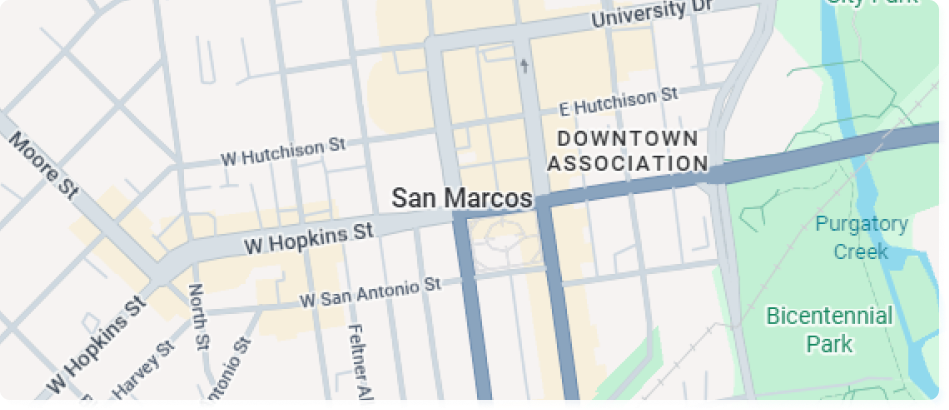
Built for the Companies That Keep This City Running
San Marcos and Kyle aren’t just fast-growing suburbs. They’re the center of the Texas Innovation Corridor, a 13-county megaregion between Austin and San Antonio with 5 million people heading toward 7 million by 2030. Forbes called it “America’s Next Great Metropolis.” The companies here are scaling in real time, building infrastructure for a region that didn’t exist at this scale a decade ago. That’s exactly where we operate best. And we’re right down I-35 in San Antonio.
Logistics, Fulfillment & Supply Chain
Amazon Hired 3,000 People in San Marcos. 240+ Supply Chain Companies Operate in Hays County.
Amazon operates an 855,000-square-foot fulfillment center in San Marcos and a 307,840-square-foot facility in Kyle, having hired more than 3,000 permanent full-time employees within five months of opening. Best Buy and more than 240 supply chain businesses employ 12,000+ people across Hays County. The I-35 corridor’s position between Austin and San Antonio gives logistics companies access to the NAFTA highway and a consumer base of 5 million people. 2 million square feet of new industrial space was recently delivered or is under construction in Kyle alone, with 2.3 million square feet of positive net absorption year-to-date. These companies process order data, payment information, customer records, and shipping logistics under PCI-DSS obligations that grow with every new facility and every new customer.
Data Centers & Cloud Infrastructure
Texas Could Become the World’s Largest Data Center Market by 2030. This Corridor Is on Every Shortlist.
Texas has 6.5 gigawatts of data center capacity under construction statewide. JLL projects Texas could overtake Northern Virginia as the world’s largest data center market by 2030. The Austin-San Antonio corridor is a secondary market with 645 megawatts of capacity, 120 megawatts of annual absorption, and a 0.6% vacancy rate. The corridor is no longer an Austin-only market. It stretches from Georgetown through San Marcos and down toward San Antonio. OpenAI’s Stargate and Vantage Frontier represent combined investments exceeding $125 billion in Texas. The companies building, operating, and relying on this infrastructure handle massive volumes of customer data, AI training datasets, and cloud-hosted applications under security attestation obligations. Compliance must be architected from the first rack, not bolted on after the facility is live.
Advanced Manufacturing & Defense Subcontracting
CFAN, RSI, and the Manufacturing Companies Choosing the Corridor Over Austin Costs
CFAN is a major San Marcos employer in advanced manufacturing. RSI in Kyle is a Department of Defense contractor. Simwon, Plastikon, ENF, and Sovereign Flavors have established Plum Creek Innovation Campus operations in Kyle. The corridor’s industries include aerospace and aviation, security and defense, material and life sciences, and information technology. Companies choose the corridor over Austin for the same reason they choose it over San Antonio: lower land costs, available industrial space, I-35 access, and a workforce that draws from both metros. The defense subcontractors in the corridor carry CMMC and ITAR obligations flowing down from primes in San Antonio and Austin. The manufacturers carry quality management requirements from their enterprise customers.
University Research & Innovation
Texas State Has 39,000 Students, an Emerging Research Designation, and STAR Park
Texas State University is the fourth-largest university in Texas with nearly 39,000 students, designated as an Emerging Research Institution and a Hispanic Serving Institute. The university’s STAR Park is a 58,000-square-foot advanced materials research center that fosters innovative young technology companies. Austin Community College operates its Hays Campus locally. The broader corridor draws from a talent pool of 1.3 million people within 45 miles, spanning five major universities from UT Austin to UTSA. The technology companies and research programs emerging from this ecosystem handle proprietary research data, student records, and customer information under FERPA, and data governance requirements that grow with every new partnership and every new commercialization.
Healthcare & Community Services
The Population Tripled. The Healthcare Infrastructure Is Catching Up.
Hays County’s population reached 269,225 and is growing at 5.1% annually. When a county grows this fast, the healthcare infrastructure must scale with it. Seton Hays provides emergency and inpatient care. Regional clinics, urgent care facilities, and telehealth providers are expanding to serve communities that doubled or tripled in a decade. The companies building patient portals, telehealth platforms, EHR integrations, and health information exchanges for this growing population handle PHI under HIPAA obligations that multiply with every new provider, every new facility, and every new patient. The platforms built for a small-town clinic are now serving a suburban health system, and the compliance gaps are already there.
Stop Duct-Taping. Start Automating.
Every patch you add to a 15-year-old system is borrowed time. You know the person who built it is gone. You know nobody fully understands what happens when X triggers Y. You know it’s going to break, you just don’t know when.
We go in, map the thing, document it properly, and build a modernization path that doesn’t take your operations offline. Then we find every manual process that should have been automated five years ago and we fix it.
40+
Hours/week recovered through automation
0
Offshore contractors touching
your data
100%
US-based
engineering team
1
Point of contact who actually
knows your stack

If You Handle Sensitive Data,
You Have Compliance Obligations. Full Stop.
We don’t just build software. We build software designed to hold up under an audit. Whether you’re preparing for security reviews, building to HIPAA requirements, or pursuing a DoD contract, we engineer with compliance in the architecture, not bolted on at the end.
PCI-DSS
Payment card data, transaction processing, e-commerce and billing compliance
HIPAA
Healthcare data for employer health plans, wellness platforms, and benefits administration
CMMC
Level 2 assessment readiness, CUI protection, NIST 800-171 control implementation
The Comparison Your CFO Needs To See
Offshore looks cheaper until you run the real numbers. Vibe coding looks faster until the auditor shows up.
Here’s what the comparison actually looks like.
Hoyack Core Service |
Hoyack (Onshore) |
Offshore/Vibe Coding |
|
Code practices built with HIPAA requirements in mind |
Built in from day one |
Assumed, rarely verified |
|
Data stays onshore (US soil) |
Guaranteed |
Often unclear or outright no |
|
Audit-ready code and logs |
Architected for it |
Retroactive fixes required |
|
Code review by human engineers |
Every commit |
AI-gen code often skipped |
|
Cyber insurance eligibility |
Documented & defensible |
Increasingly at risk |
|
Legacy system knowledge transfer |
Full documentation |
Knowledge walks when contract ends |
|
Real total cost (incl. rework, risk, delay) |
Predictable |
Unpredictable & compounding |
If You’re Not Sure Where Your Gaps Are, That’s the Problem.
We’ll do a no-pressure technical assessment of your current stack, compliance posture, and automation opportunities. You’ll walk away knowing exactly what’s at risk, and what it takes to fix it.