Dayton, Ohio
Where the Air Force Builds Its Future.
The Code Behind It Has to Keep Up.
Wright-Patterson AFB employs 38,000+ people and generates $19.4 billion in economic activity. Home to AFRL headquarters, the Air Force Life Cycle Management Center, NASIC, and AFWERX. Workforce has doubled in two decades. Hiring 2,000 more civilians in 2026. We’re the onshore engineering team that keeps defense R&D and acquisition code documented and audit-ready.

Vibe Coding Just Shipped to an AFRL Research Platform
AI-generated code ships fast and looks clean. Until the CMMC assessor or the contracting officer finds the gap. When your code touches CUI on a research program at the birthplace of Air Force science and technology, “it passed review” isn’t a defense.
Your Offshore Team Has Access to Acquisition Data
ITAR, CMMC, and DFARS don’t care where your contractor sits. If they’re touching export-controlled research data, acquisition records, or program management systems from overseas, you’re disqualified from the contract.
Your Support System Was Built Three Contract Vehicles Ago
The prime changed hands. The subcontractor rotated. The code stayed. Nobody who built it is still on the team. One bad deployment, and your acquisition management tools, research data pipelines, or intelligence analysis platforms go dark.
The Risks Nobody Talks About Until It’s Too Late
01
Vibe Coding Is a CMMC Violation Waiting to Happen
Your dev team is using AI to ship faster. That’s fine. Until it isn’t. AI-generated code doesn’t get reviewed the way human-written code does. It introduces logic errors, insecure dependencies, and auth gaps that slip through because nobody fully understands what was generated. In a city where contractors build research tools for AFRL, acquisition platforms for AFLCMC, and intelligence systems for NASIC, one unchecked endpoint isn’t just a bug. It’s a CMMC assessment failure and a contract disqualification at the nerve center of Air Force R&D.
02
Offshore Isn’t an Option When Research Data Is Involved
This isn’t about cost savings. It’s about eligibility. ITAR prohibits sharing defense-related technical data with foreign nationals. CMMC requires protecting CUI within U.S.-controlled environments. DFARS 252.204-7012 mandates specific cyber incident reporting. If your offshore team has access to Air Force research data, acquisition records, or intelligence analysis tools, you’re not just exposed. You’re done competing in the Wright-Patterson ecosystem.
03
Your Defense Platform Survived Three Contract Transitions
The prime changed hands. The sub rotated. The integration contractor was recompeted. Through all of it, the code stayed. Nobody who built it is still on the team. The documentation was written for requirements that were updated two contract vehicles ago. One bad update, one deprecated library, one new integration, and your research management, logistics tracking, or acquisition workflow tools go dark.
04
CMMC 2.0 Is Here and Wright-Patt Contractors Are First in Line
CMMC is no longer theoretical. The DoD is requiring certified compliance as a condition of contract award. Level 2 requires third-party assessments against 110 NIST SP 800-171 controls. With Wright-Patterson housing AFRL, AFLCMC, and the largest concentration of Air Force acquisition professionals in the country, the contractors supporting these missions are among the first facing mandatory assessments. Self-attestation is no longer sufficient for most contracts.
05
Cyber Insurers Are Asking Defense-Grade Questions
The days of filling out a form and getting a policy are over. Underwriters are asking technical questions that mirror CMMC controls. Do you have MFA everywhere? How is your code reviewed? What’s your incident response plan? Do you have a System Security Plan? If vibe-coded features are processing CUI or research data with no audit trail, your claim could be denied. Or your premium just tripled.
06
You’re Automating the Easy Parts, Not the Expensive Ones
Most teams automate the easy stuff. The hard stuff (legacy acquisition workflows, manual CMMC evidence collection, cross-system research data pipelines, compliance documentation for re-compete proposals) stays manual because nobody wants to touch it. That’s exactly where your operational costs are hiding. We’ve seen defense contractors cut 40+ hours of manual work per week by automating the workflows everyone assumed were too complicated.
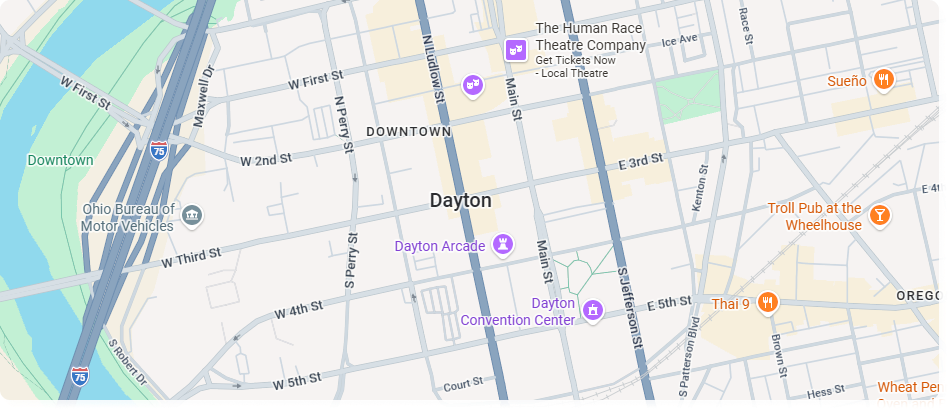
Built for the Companies That Keep This City Running
Dayton isn’t just another defense market. It’s where the Air Force does its thinking, its buying, and its building. Wright-Patterson houses AFRL headquarters, the Air Force Life Cycle Management Center, the National Air and Space Intelligence Center, and AFWERX. The base’s workforce has doubled in the last two decades. $19.4 billion in total economic activity. 17% of the regional economy. That’s exactly where we operate best.
Defense R&D & Research Support
AFRL Headquarters Is Here. The Research Code Has to Be Airtight.
The Air Force Research Laboratory is headquartered at Wright-Patterson, leading the discovery and delivery of warfighting technologies across air, space, and cyberspace. AFWERX, the innovation arm of the Department of the Air Force, structures SBIR investments with defined transition pathways. The Materials and Manufacturing Directorate develops advanced manufacturing technologies. The Air Vehicles Directorate designs next-generation aircraft. The 711th Human Performance Wing advances aerospace medicine and human systems integration. Every system supporting these missions handles CUI, research data, and often classified information. CMMC Level 2, NIST SP 800-171, and ITAR create overlapping obligations where the code itself is part of the research infrastructure.
Acquisition & Life Cycle Management
AFLCMC Manages $70B+ in Annual Acquisitions From Here
The Air Force Life Cycle Management Center at Wright-Patterson is the single largest center in the Air Force Materiel Command, managing the acquisition, development, and sustainment of Air Force weapon systems. AFLCMC is hiring 2,000 new civilian employees in 2026 to refresh talent following a 25% increase in retirements. The contractors supporting these offices build acquisition management tools, program tracking systems, cost estimation platforms, and compliance reporting pipelines. Every one of these systems handles sensitive acquisition data under CMMC, DFARS, and federal acquisition regulation requirements. When acquisition tools fail, weapon system timelines slip.
Intelligence & Cyber Operations
NASIC Analyzes Foreign Threats From Dayton
The National Air and Space Intelligence Center at Wright-Patterson provides integrated intelligence analysis on foreign air, space, and cyber threats. DIA maintains operations in the region. The broader cybersecurity workforce supports both military and contractor missions. These organizations handle classified intelligence, signals data, and threat analysis at the highest sensitivity levels. The contractors building analysis tools, data fusion platforms, and intelligence dashboards for these missions carry the most stringent compliance requirements in the defense industrial base. Offshore contractors and unreviewed AI-generated code don’t belong anywhere near these systems.
Defense Contractors & Engineering Services
The Wright-Patt Ecosystem Runs on Contractor Innovation
The Wright-Patterson contractor ecosystem is expanding fast. MTSI grew past 500 employees in the Dayton market in 2025 and expanded its facility to over 30,000 square feet. Sierra Nevada Corporation is building two new hangars at Dayton International Airport in partnership with Wright-Patterson. Joby Aviation committed $500 million in expansion at Dayton International. Booz Allen Hamilton, Lockheed Martin, and dozens of specialized defense engineering firms all operate from the region. In 2025, the Dayton Development Coalition announced $1.2 billion in capital investment projects generating 2,500+ new jobs. Every tier of the supply chain carries CMMC obligations flowing down from the primes.
Advanced Manufacturing & Aviation
The Birthplace of Aviation Is Building Its Next Chapter
Dayton’s manufacturing DNA runs deep, from the Wright brothers to today’s advanced manufacturing corridor. Joby Aviation’s $500 million expansion at Dayton International Airport is bringing electric air mobility manufacturing to the region. Henny Penny, Midmark, Nidec, and Norwood Medical are experiencing global success from Dayton. Honda invested $4.5 billion in nearby Fayette County. The logistics sector employs 40,000 people with $3.8 billion in annual economic impact. These companies carry data obligations across manufacturing execution systems, supply chain platforms, and increasingly connected factory infrastructure. IP protection, customer data security, and security attestation requirements for enterprise partnerships create compliance surfaces that grow with every new contract.
Stop Duct-Taping. Start Automating.
Every patch you add to a 15-year-old system is borrowed time. You know the person who built it is gone. You know nobody fully understands what happens when X triggers Y. You know it’s going to break, you just don’t know when.
We go in, map the thing, document it properly, and build a modernization path that doesn’t take your operations offline. Then we find every manual process that should have been automated five years ago and we fix it.
40+
Hours/week recovered through automation
0
Offshore contractors touching
your data
100%
US-based
engineering team
1
Point of contact who actually
knows your stack

If You Handle Sensitive Data,
You Have Compliance Obligations. Full Stop.
We don’t just build software. We build software designed to hold up under an assessment. Whether you’re preparing for CMMC Level 2, implementing NIST SP 800-171 controls, maintaining ITAR compliance, or passing security reviews from commercial partners, we engineer with compliance in the architecture, not bolted on at the end.
CMMC
Level 2 assessment readiness, CUI protection, NIST 800-171 control implementation
ITAR
Export control compliance, defense article restrictions, U.S. person requirements
DFARS
Defense procurement compliance, 252.204-7012 cyber incident reporting, CUI safeguards
The Comparison Your CFO Needs To See
Offshore looks cheaper until you run the real numbers. Vibe coding looks faster until the auditor shows up.
Here’s what the comparison actually looks like.
Hoyack Core Service |
Hoyack (Onshore) |
Offshore/Vibe Coding |
|
HIPAA & compliance-safe code practices |
Built in from day one |
Assumed, rarely verified |
|
Data stays onshore (US soil) |
Guaranteed |
Often unclear or outright no |
|
Audit-ready code and logs |
Architected for it |
Retroactive fixes required |
|
Code review by human engineers |
Every commit |
AI-gen code often skipped |
|
Cyber insurance eligibility |
Documented & defensible |
Increasingly at risk |
|
Legacy system knowledge transfer |
Full documentation |
Knowledge walks when contract ends |
|
Real total cost (incl. rework, risk, delay) |
Predictable |
Unpredictable & compounding |
If You’re Not Sure Where Your Gaps Are, That’s the Problem.
We’ll do a no-pressure technical assessment of your current stack, compliance posture, and automation opportunities. You’ll walk away knowing exactly what’s at risk, and what it takes to fix it.