Defense & Aerospace Engineering
Software Built For The DoD, The Prime, And The Assessor Behind Them.
ISO/IEC 42001 readiness. Custom software and AI governance work for teams where the assessment is part of the delivery.
Offshore is a non-starter when controlled unclassified information is in play. AI-generated code shipped without review is the new version of the same problem. Hoyack is the onshore, clearance-aware partner that builds alongside your team, reviews what AI writes, and keeps the evidence trail intact.
In Regulated Environments, Shipping Is Half The Work. Proving It Shipped Correctly Is The Other Half.
In defense, aerospace, federal, and GRC-heavy enterprise work, the code is judged twice. Once by the user. Once by the assessor. The user wants it to work. The assessor wants evidence that every control it claims is implemented, enforced, and documented. When those two audiences disagree about whether you’re done, the assessor wins. And most software organizations find this out too late.
Offshore vendors are reliably wrong for this work. CUI handled outside the United States is a compliance problem, not a cost optimization. Foreign persons with access to AI systems in scope for an ISO/IEC 42001 readiness review can fail that review on day one. AI-generated code shipped without human review is a new flavor of the same problem: provenance your assessor can’t trace, and controls your team didn’t implement because nobody wrote them. The specification, the architecture, the build process, and the evidence collection all have to reflect the framework from the first commit.
The difference between a codebase that passes assessment and a codebase that stalls in POA&M for a year isn’t talent. It’s governance. And governance has to be designed in, not assessed in.
Here’s What Happens When Regulated Software Isn’t Built For
The Framework It’s Being Assessed Against.
These are the failure points we see in ISO/IEC 42001 readiness reviews and AI governance audits when software and agents were built by teams who understood code but not controls. Each one is a real cost. Each one was preventable months earlier.
SCENARIO 01: The ISO/IEC 42001 readiness review
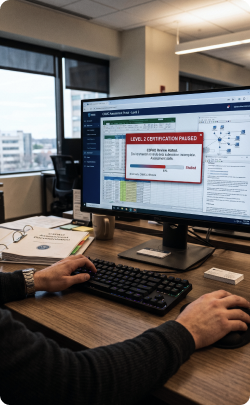
Your C3PAO Opens The Environment. The Level 2 Certification Stalls.
You’ve started preparing for ISO/IEC 42001. A readiness review begins. In the first week it documents: AI systems and agents that were never inventoried, no clear owner for each system, credentials and tool access that nobody can explain, logging that does not support monitoring, and AI-generated code in production with no review trail. The product works. The AI management system does not. The gaps against clauses 4 through 10 and Annex A have no owners and no treatments.
What Actually Happens
The certification goes into POA&M limbo. Your DoD contract opportunity pauses. The prime you’re subbing under starts asking about alternates. And your remediation runs six to twelve months longer than the original build did.

SCENARIO 02: The FedRAMP Authorization
You Promised A FedRAMP Path. The Architecture Can’t Support One.
You sold into a federal customer on the promise of a FedRAMP Moderate authorization within a defined window. Your 3PAO starts the readiness review. The architecture wasn’t designed for FedRAMP baseline controls: no dedicated GovCloud enclave, shared tenancy decisions that should have been made differently, logging and monitoring that won’t scale to continuous monitoring requirements, and an SSP that would need to be written from scratch because the implementation doesn’t actually align with your draft. The code runs. The authorization path doesn’t.
What Actually Happens
Your federal customer’s ATO expires or their sponsor withdraws. Revenue commitments shift a fiscal year. Your sales team loses a story they can’t tell to the next federal prospect, because the reference customer never got authorized on your platform.

SCENARIO 03: The Clearance And Access Problem
Your Codebase Was Touched By Foreign Persons.
Your Contract Won’t Allow It.
Your prime contractor flows down export control and foreign person restrictions. Your build system pulls from a repo that had commits from offshore engineers six quarters ago. Your production environment uses a CI runner hosted in a jurisdiction your contract doesn’t cover. Your dependency tree includes packages maintained abroad that don’t meet your supply chain attestation requirements. Nobody on your side was looking for any of this during the original build. Your prime’s security team is looking for it now.
What Actually Happens
Facility clearance sponsor is notified. Access is suspended while remediation is scoped. Contract flow-down clauses get enforced. Your company has to demonstrate a path to a clean codebase, or the prime finds an alternate sub. You are now the story instead of the solution.

SCENARIO 04: The Enterprise GRC Review
Your Enterprise Customer’s GRC Team Sends
A 300-Question Security Questionnaire.
A Fortune 500 customer is ready to buy. Then procurement hands over the security questionnaire. SIG Lite, CAIQ, a custom supplement, and a third-party risk management review. Hundreds of questions. Every answer has to map to evidence. Your codebase wasn’t designed for the evidence model they’re asking about: no documented SDLC with approvals, no separation of duties in your change management, no continuous monitoring, no vulnerability disclosure program, no Software Bill of Materials, no attestation for your dependencies. Your account executive asks how long answering will take. The answer is months.
What Actually Happens
The sales cycle doubles. Your customer’s GRC team becomes a de facto project manager for your remediation. Your competitor, who built for GRC from day one, closes the deal while you’re still assembling SBOM documentation and signing artifacts you never generated in the first place.
The Pattern Is Always the Same
In every scenario above, the engineering team built software. They didn’t build evidence. In regulated environments those are not the same thing. The code only counts once the assessor agrees it counts. And the assessor operates from a framework (800-171, FedRAMP baseline, commercial trust-services criteria, whatever applies) that has to be reflected in the architecture, the pipeline, the access model, and the paper trail from commit one.
Most offshore and generalist shops treat compliance as a document exercise handled by a separate team at the end. We treat it as an engineering exercise handled by the same team doing the build. Evidence is a first-class output alongside working code. SSP sections, SBOM entries, access logs, change records, and control mappings are generated as a byproduct of the build process, not reconstructed from memory at assessment time.
The difference shows up once, dramatically, when the assessor arrives. Every answer is a lookup. Every control has a pointer to the implementation. Every piece of evidence already exists. That’s not a compliance program. That’s an engineering culture that knew who it was building for.

What Hoyack Does
We work with defense contractors, aerospace primes and subs, federal SaaS vendors, and GRC-heavy enterprises who need custom software that ships with its evidence trail built in. Every engagement is staffed with senior US engineers, onshore, with no offshore handoff and no nearshore loophole.

ISO/IEC 42001 readiness and gap assessment
Paid readiness work for teams already using AI. We inventory the systems and agents in scope, map gaps against ISO/IEC 42001 clauses 4 through 10 and Annex A, review agent risk, and hand you a sequenced roadmap and leadership readout. Hoyack recommends. You decide. We do not certify.

FedRAMP-Aware SaaS And Platform Development
Architectures designed with FedRAMP Moderate or High baselines in mind from day one. GovCloud awareness. Continuous monitoring hooks. Logging, auditing, and SSP-ready documentation as build artifacts. Your 3PAO doesn’t have to reverse-engineer your environment.

Aerospace And Mission-Critical Engineering
Software for aerospace primes, defense contractors, and mission-critical systems where downtime, drift, and unverified inputs have real consequences. Deterministic behavior, documented failure modes, and delivery processes that match aerospace program discipline.

GRC And Audit-Ready Enterprise Software
Custom software for regulated enterprises selling into Fortune 500 GRC teams, federal customers, or regulated industries. Evidence collection mapped to NIST 800-53 and the SIG and CAIQ questionnaires your buyers send. The 300-question security questionnaire becomes a filing exercise, not a three-month project.
Hoyack is a software development firm based in San Antonio, TX. We work with DoD contractors, aerospace primes, federal SaaS vendors, and GRC-heavy enterprises where compliance is not an afterthought, it is the deliverable. Every engagement is staffed with senior American engineers. We do not subcontract offshore. We do not route work through nearshore partners. We do not have a hybrid team where the senior US name is on the SOW and the actual work happens elsewhere.
We have sat on the other side of the assessment. We help clients prepare AI management systems aligned to ISO/IEC 42001. We review AI-generated code before it lands in systems that matter. We work alongside your team as a partner, not a handoff. That is what regulated software looks like when it is built right. That is what we build.
Before The Assessor Finds It For You.
30 minutes with a senior US engineer who has shipped in regulated and mission-critical environments. We name the gaps. No obligation.